The Star Trek Economy: Who Pays Rent on the Enterprise?
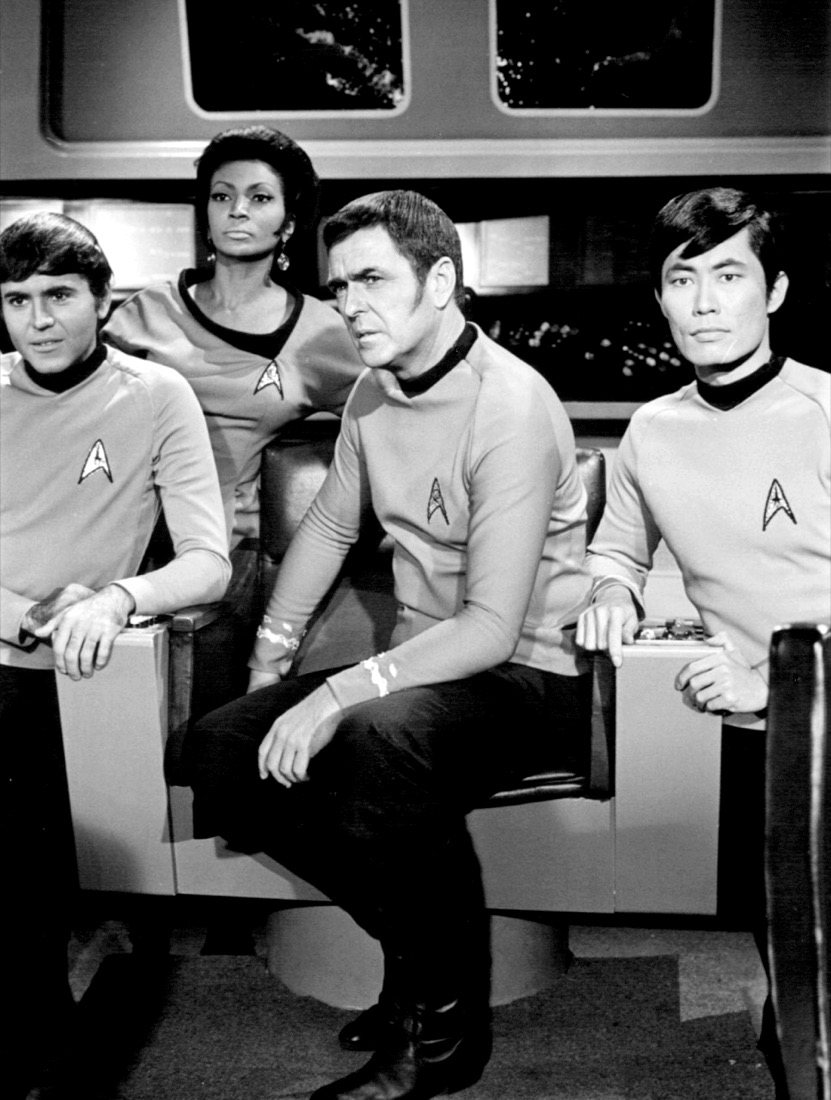
In the original TV series ...
Kirk isn't worried about his mortgage.
Spock isn't negotiating his salary.
McCoy doesn't wonder whether he can afford medical treatment.
Nobody has to work overtime aboard the Enterprise to make rent.
Roddenberry removed money from ordinary daily life. ... As far as we can see, no cash, no bank accounts, no investments. But also---no poverty. Food comes on a tray when you touch a button on the wall. Uniforms are everywhere, and no one seems to bother about laundry or housework.
How did Gene Roddenberry imagine this future? By extrapolating the optimism of the 1960s and riding the space race beyond our solar system. He kept government---a federation of planetary civilizations organized along democratic lines---and he kept medicine, too.
Starfleet has a clearly defined hierarchy. The Enterprise crew are all assigned duties and ranks. These are their careers. There are promotions and recognition. People still own possessions and encounter objects that are rare or valuable. But they don't have to pay rent or a mortgage. They simply live.
So, who does pay rent on the Enterprise?
Nobody. There simply isn't any rent anymore.
What has changed is that everyone performs their role---assigned, demanded, or simply found by default. And the lights turn on, the transporter beams you up, and warp drive engages. It's a frictionless machine, mostly, that hums along efficiently and abundantly.
But the Star Trek universe isn't a utopia either. Things still break, disagreements arise, and old grudges are held. Diseases stalk the galaxy, the young and the old still see things differently, and even Dr. McCoy hasn't discovered immortality.
Yet.
Roddenberry didn't make money unnecessary by making problems disappear. He imagined that certain kinds of problems had disappeared while human problems remained.
Even without much use of money, exchanges still take place. Orders are given and carried out. The crew trades barbs and struggles to understand alien races. There is the quest for order and the struggle against injustice.
And there is still the pursuit of love.
But there's no scarcity of basic necessities. All of today's human struggles are still with us in the 23rd century. It's just that the essentials of daily life seem to materialize effortlessly.
Scarcity has driven human behavior throughout our history. We struggle for the most productive land, the most valuable resources and the most desirable treasure.
What Star Trek shows us is that even if our most basic needs are easily met, there will still be conflict, misunderstanding and suffering.
And death.
Some might say that Star Trek was set in an impossible utopia. But Gene Roddenberry didn't imagine perfect people. He imagined imperfect people living beyond material desperation.
What changed is the economy.
There are very few farmers on the Enterprise. But everybody eats. Machines and automation take care of routine tasks and heavy lifting. Physical goods like food and uniforms just appear, as if 3-D printing and additive manufacturing grew up along with the interstellar drive.
In a 1999 NPR interview, science-fiction writer William Gibson observed, "The future is already here---it's just not very evenly distributed." Perhaps abundance is on the way or already here, too. It's just not evenly distributed. Yet.
Necessities are available to everyone aboard the Enterprise. People still accumulate status, possessions, authority and achievement. Survival isn't contingent upon the struggle for food, clothing and shelter.
But having a lot doesn't solve all your problems. A person with very little may find contentment in what they do have. Someone possessing vastly more may be obsessed with getting even more.
How much is enough when you're certain there's never enough?
For most of history, a world of abundance could be dismissed as an impossible dream. For the first time, we are developing technologies that force us to consider a more uncomfortable possibility: perhaps the barrier between scarcity and abundance isn't simply what we produce.
What if we produce more but the benefits remain highly concentrated? Will increasing abundance automatically mean increasing access? What if there's enough to go around, it just doesn't make it around?
What if the human condition were no longer built around the struggle for basic needs? What would human beings do then? And Roddenberry's answer is surprisingly ordinary.
We explore.
We learn.
We work.
We compete.
We create.
We fall in love.
We disagree.
We screw things up.
We grow old.
We die.
And that reveals something about us. We still have problems. They're just better problems.
Who pays the rent on the Enterprise?
Nobody.
Technology can make abundance possible. Technology cannot decide how its benefits are shared.
Same machines.
Same energy.
Different distribution.
It's not the technology that needs to change.
It's us.